





PRO Line Indium 200
REQUEST A QUOTE
PRO Line Indium 200
Designed to Produce Precise Indium Bumps at a Longer Throw Distance for Flip Chip Applications

Automate
Your Lab.
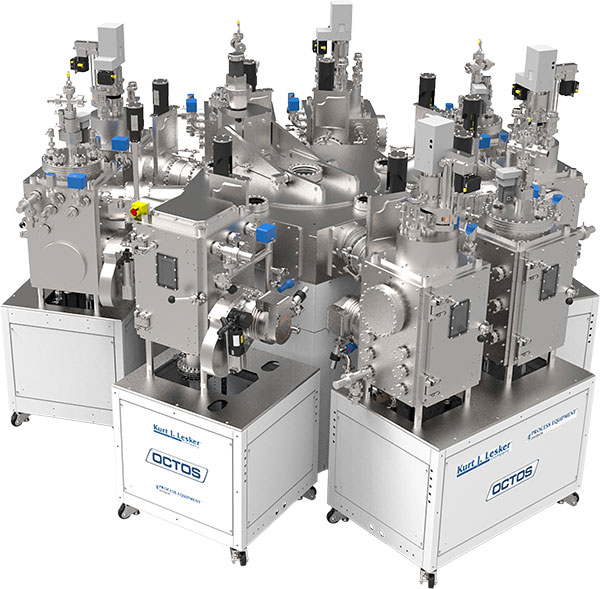
The Kurt J. Lesker Company® PRO Line Indium 200 is a full-featured thin film deposition system allowing depositions on wafers up to 200mm utilizing our advanced eKLipse control software. The PRO Line Indium 200 builds on the successes of the PVD 200 platform while being specifically designed for indium bump processing. A technically superior chamber design provides LN2 cooled substrates, thick indium depositions (up to 20µm), and extremely high deposition rates exceeding 100 Å/second. KJLC's eKLipse software control system allows stable rates, with long deposition runs allowing 10 wafers to be processed before breaking vacuum.
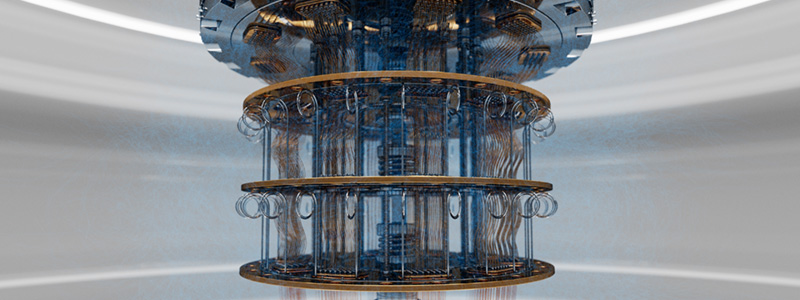
Indium bump bonding is a technique used to create reliable and low-loss 3D flip-chip interconnects in superconducting circuits for quantum applications. Indium forms strong, stable bonds at room temperature that stay robust even at milli-Kelvin temperatures, due to its self-bonding ability and lack of brittleness at cryogenic levels. Its superconductivity at 3.4K also makes it ideal for low-loss quantum circuit bonds.
Indium bumps can easily be fabricated in Kurt J. Lesker's PRO Line Indium physical vapor deposition (PVD) systems. Interested in creating indium bumps for your application? Then let's look at the key building blocks you will need for of an indium bump bond tool:
The Kurt J. Lesker Indium PVD200 is an evaporation platform engineered and optimized for the fabrication of indium bump bonds. It offers user-friendly operation and streamlines maintenance, providing a reliable and versatile solution for this application.
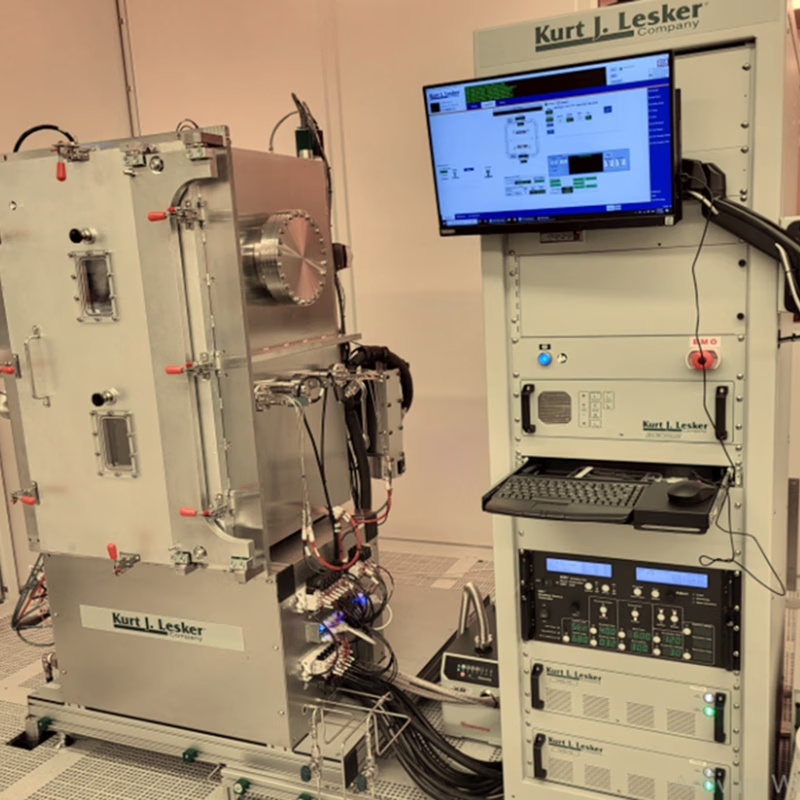
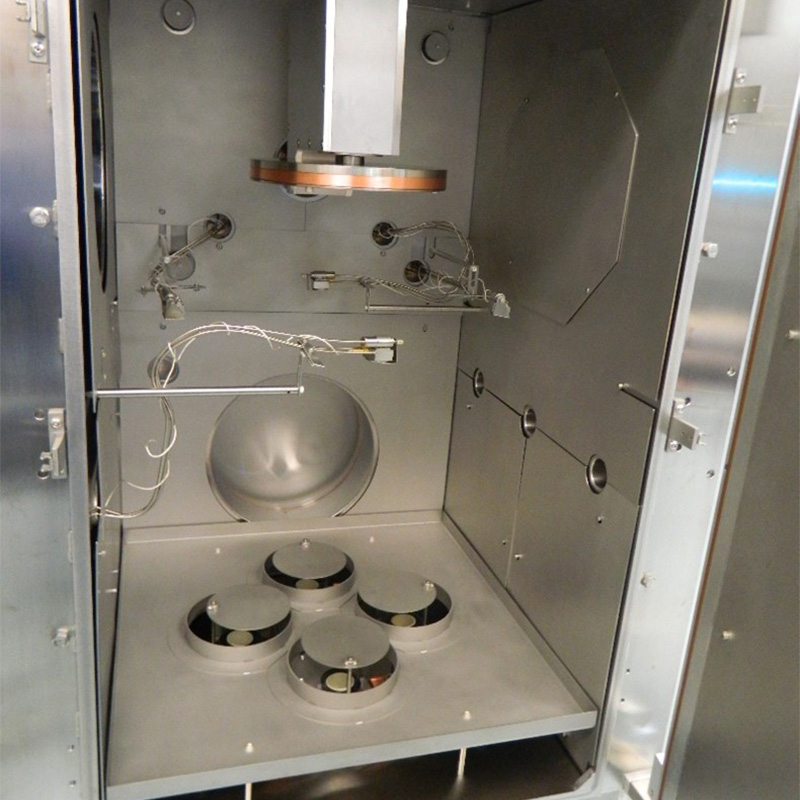
Process Chamber - The process chamber features an optimized geometry and size to promote excellent film uniformity and efficient material utilization. The source-to-substrate distance is set at a minimum of 15.5" (39.4 cm) to limit indium energy and reduce substrate heat load, while supporting high deposition rates exceeding 100 Å/sec (source and throw distance dependent). This configuration facilitates superior vertical growth of indium necessary for forming high aspect ratio bumps with robust lift-off characteristics. Cryogenic pumping maintains low base pressures, thereby reducing contamination risk and enabling rapid transition from atmospheric to process pressure. Removable deposition shields are incorporated to facilitate efficient indium reclamation, contributing to cost-effective material usage.
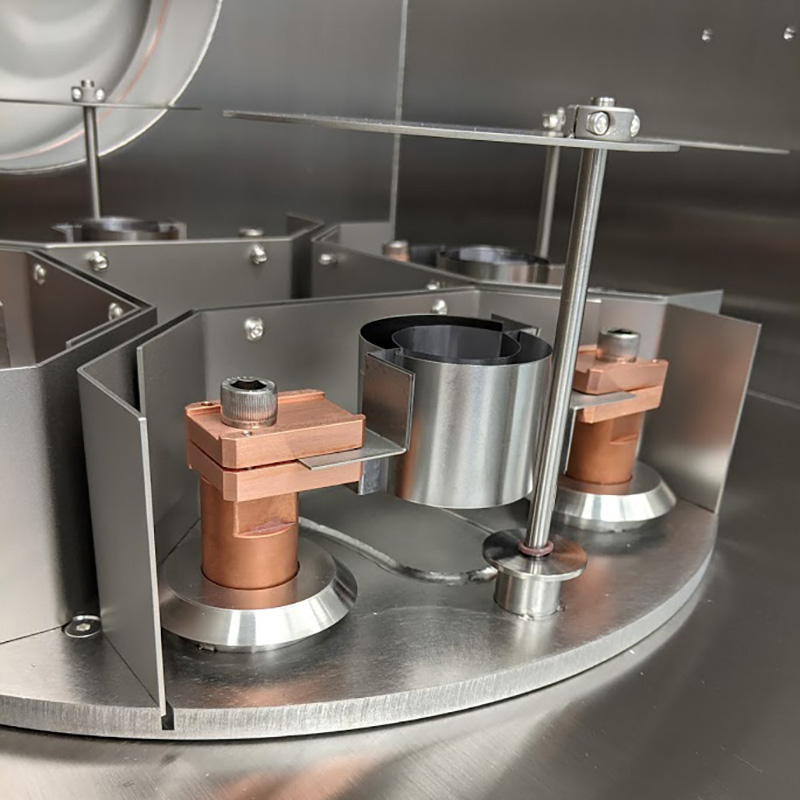
Indium Evaporation Sources - Up to four high-capacity, shuttered thermal evaporation sources and KJLC material feeder facilitate the deposition of indium films up to 20 microns in thickness, with highly stable evaporation rates exceeding 100 Å/sec (source and throw distance dependent). This configuration ensures sufficient energy for the growth of indium bumps exhibiting high crystallinity and smooth surfaces with fine grain sizes.
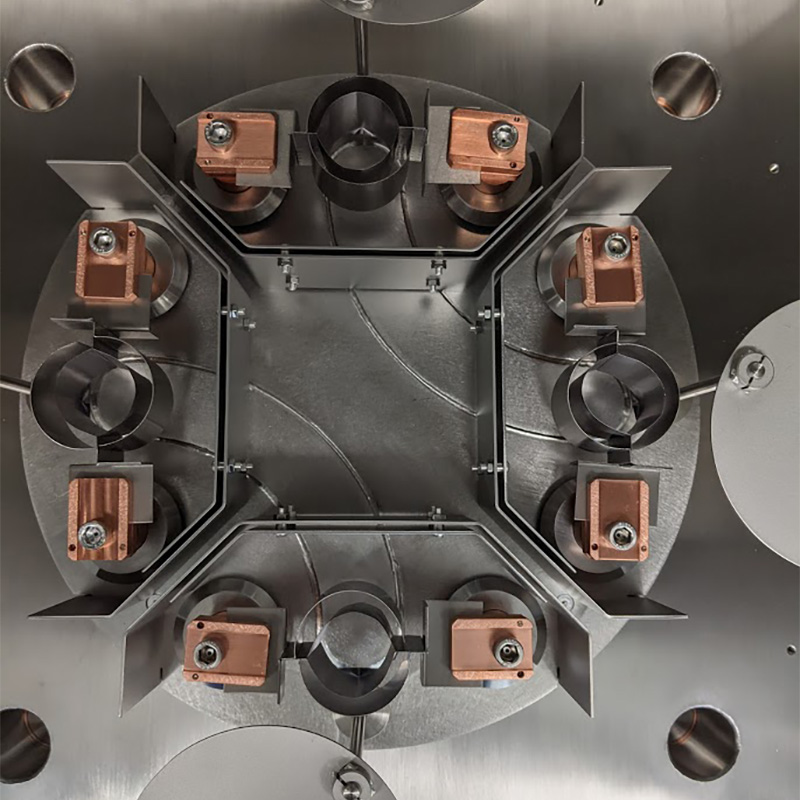
Base Flange - Due to indium's melting point of 157°C and evaporation temperatures exceeding 600°C, it is essential to shield critical components from exposure to liquid indium. Implementing water-cooling for the base flange and other vital parts enables stray indium to condense safely, minimizing the risk of electrical shorting during processing and ensuring optimal operational uptime.
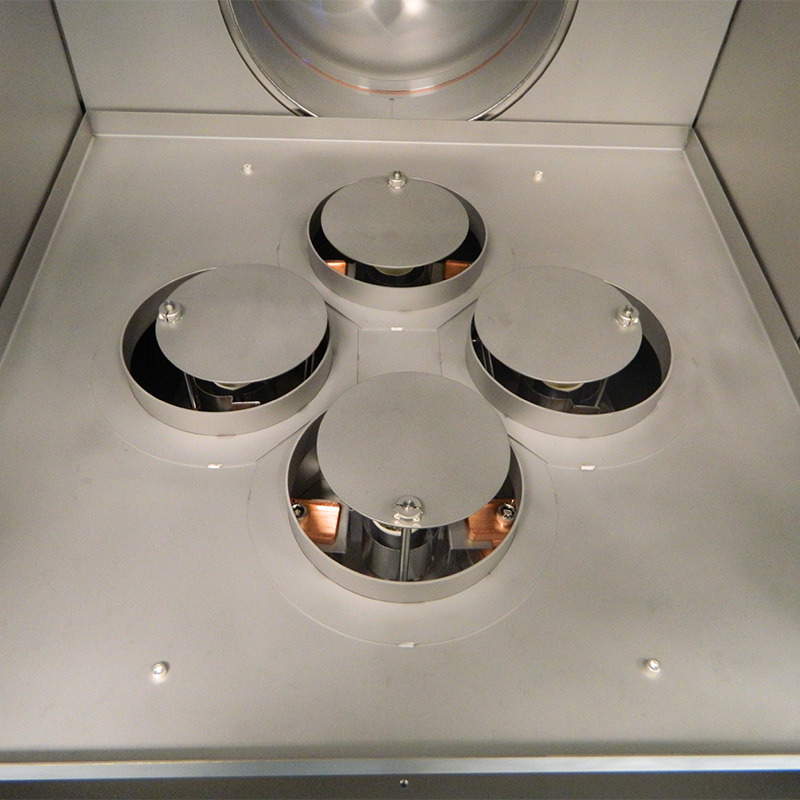
Source Protection - Deposition shields and drip trays are used to maintain process uptime and simplify maintenance. The water-cooling system, combined with shielding, reduces the heat load caused by thermal evaporation and enables extended high-rate process runs of up to 3 hours per source.
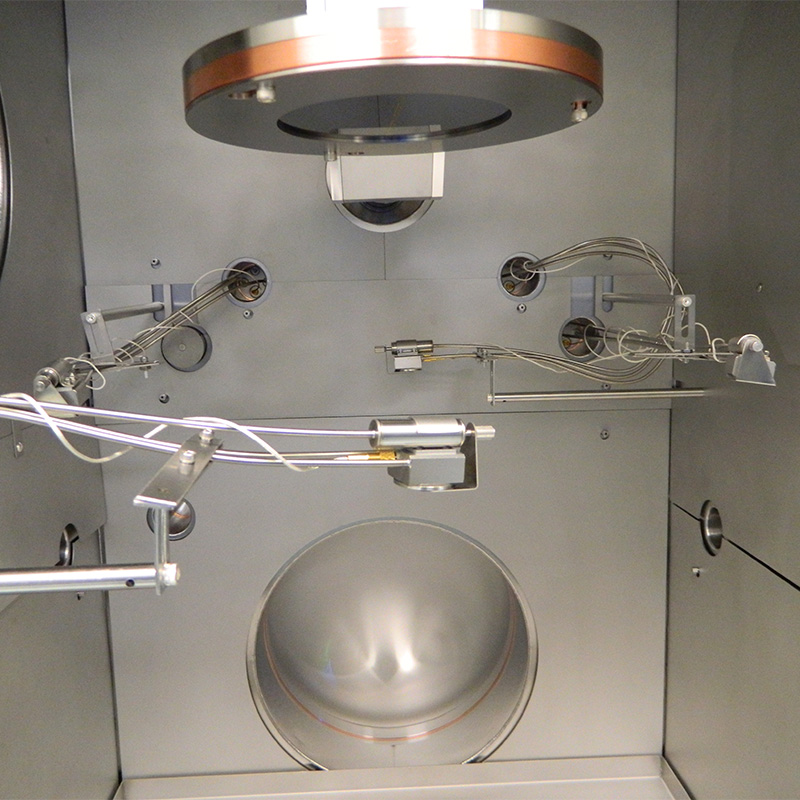
Indium Flux Monitoring - Indium flux monitoring is achieved using fixed-position shuttered quartz crystal microbalances, ensuring precise rate measurement necessary for producing thick indium films. This system offers superior control over film thickness and deposition rates through the integration of KJLC's engineered eKLipse™ software and controls package. Consistent rate management and accurate film thickness termination facilitate repeatable and reliable processing.
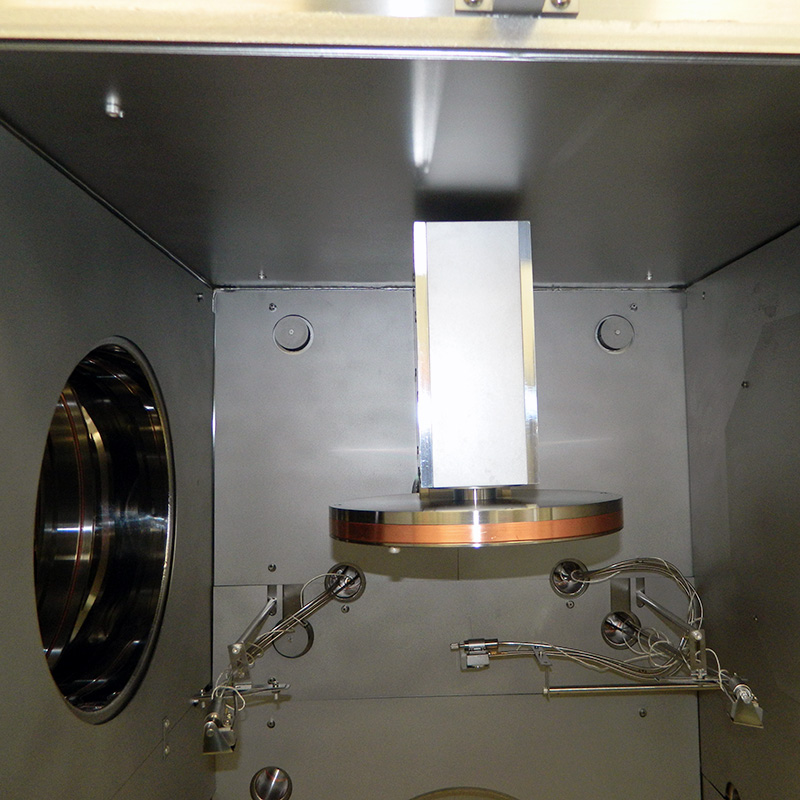
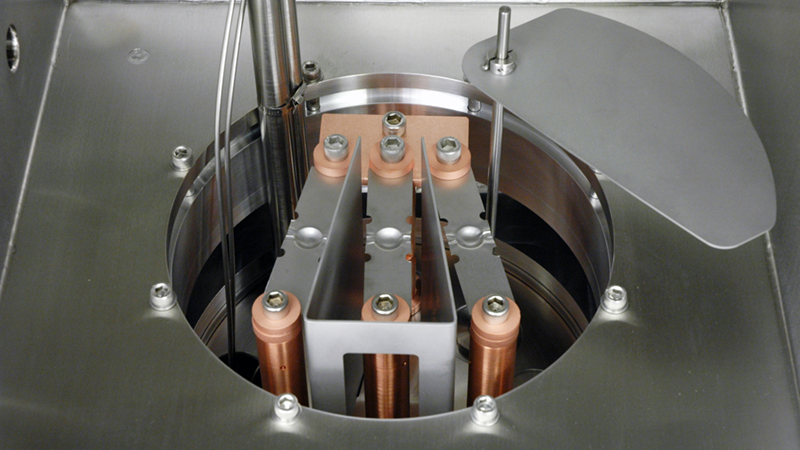
Substrate Fixture - Multiple available substrate fixtures capable of operating at LN2 temperatures, or -30°C with rotating fixtures. Precision tilting and rotating fixtures are available to enable the formation of high aspect ratio indium films. Substrate cooling promotes out-of-plane indium growth, resulting in fine grain structures and smooth film surfaces ideal for bump bonding applications. Indium bumps can be deposited by employing substrate masks affixed to the fixture.
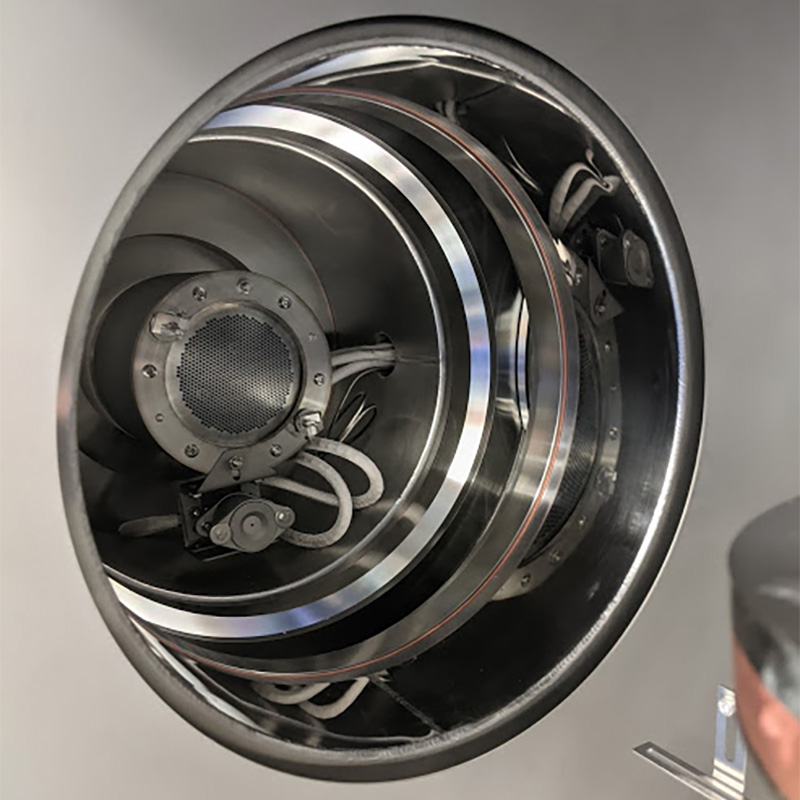
Ion Source - The ion source, positioned either in a separate cooled chamber or within a isolated housing inside the process chamber, is safeguarded from indium contamination. Featuring a gridded design with an optional filament neutralizer, it effectively removes the oxide layer that forms on indium and can perform a light etch on the deposited metallic film. As a result, the indium film remains virtually free from contamination, ensuring optimal interfaces for bonding.
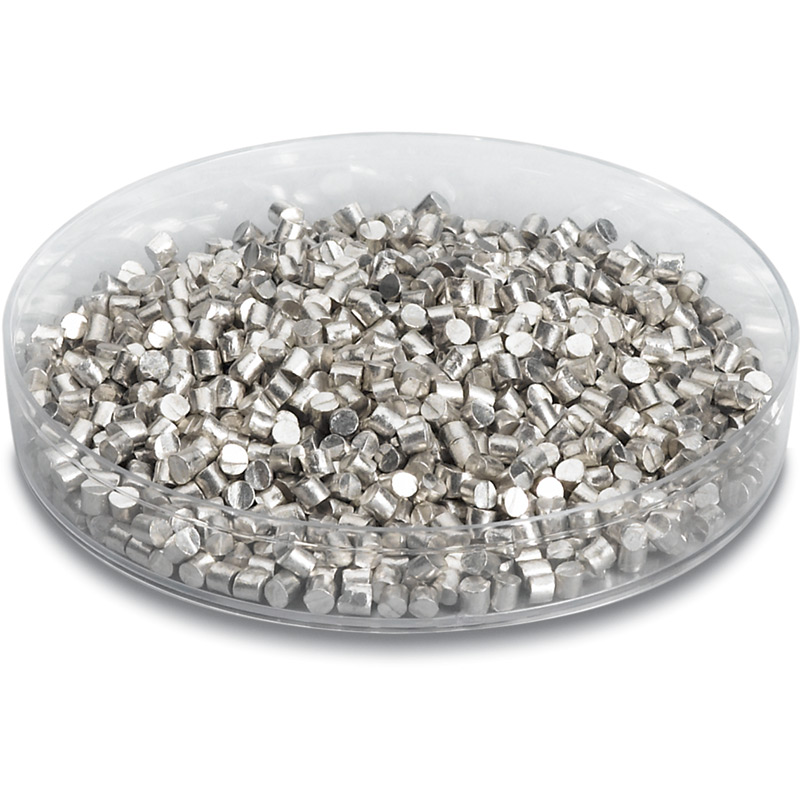
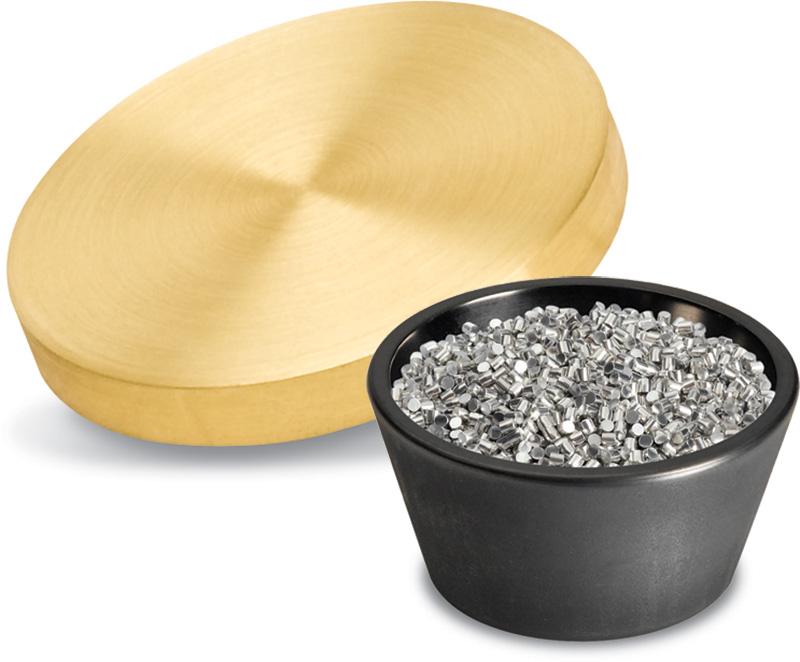
Indium Metal - Kurt J. Lesker Company offers high-purity indium metal in both pellet and wire forms, suitable for use in bump fabrication. The Kurt J. Lesker Company provides detailed indium evaporation guidelines and access to thin film process experts who are available to assist with technical inquiries related to indium bump fabrication.
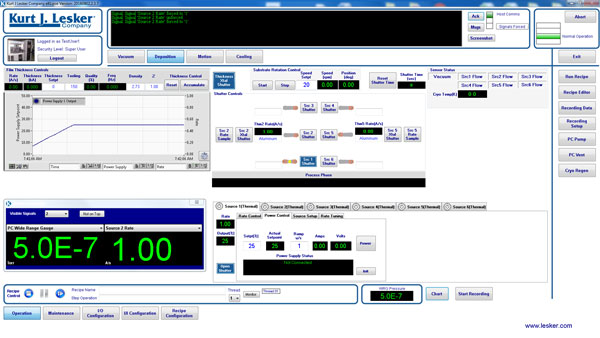
Controls - The KJLC eKLipse™ Real-Time Controls Platform facilitates precise and accurate deposition of high aspect ratio indium bump films. Each custom-engineered system offers the following standard features:
- Intuitive user interface
- Remote support with email notification capabilities
- Scalable and extensible recipe engine featuring import/export utilities
- Comprehensive 'one button' operation for unattended, customer-defined process execution
- Compatibility with over 125 industry-standard device interfaces, including pumps, valves, power supplies, gauges, metrology equipment, and more
PUMPING PERFORMANCE
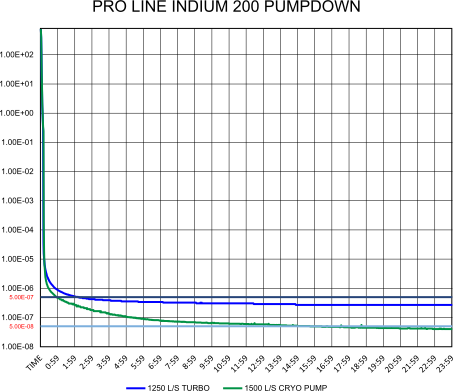
*Pump curves for a clean dry and empty PRO Line Indium 200. Pumping performance is depending on chamber conditions and components installed.
The PRO Line Indium 200 offers two types of high vacuum pumping on its process chamber: Pfeiffer 1250L/s turbomolecular pump (optional), Brooks CTI-8F 1500 L/s (optional Cryo). Pfeiffer turbomolecular pumps being a good choice for overall cost effective high quality pumping. The Brook CTI cryo pumps find use in applications that require the lowest vacuum possible, particularly for thermal evaporation.
The chart (above) demonstrates average expected pumping performance by pump type for an outfitted PRO Line Indium 200 process chamber that is clean and dry with an ion source, two indium sources and a cooled, rotating tilting stage.
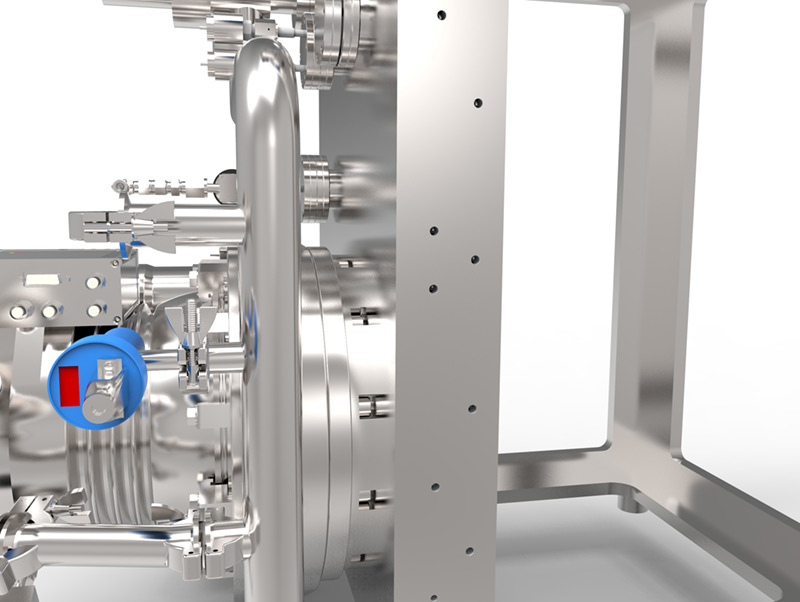
The Indium 200 was re-designed to mount the high vacuum valve directly to the process chamber without the 4" half nipple and accommodates a larger 1250L/s pump or CTI8 pump. This allows the PRO Indium PVD 200 to reach lower base pressures and faster pumpdown times than similarly equipped systems.
DEPOSITION PERFORMANCE
The PRO Indium PVD 200 has been designed for optimal uniformities and allows ultimate base pressures otherwise not achievable in modular R&D systems until now. The chart above shows average expected uniformity by deposition type and substrate wafer diameter. Thickness measurements were made using a Profilometer or spectral reflectometer. The actual uniformity achievable will be a function of the final configuration of the system and process parameters.
- All Films are measured on a properly calibrated Profilometer, Reflectometer or Ellipsometer (if applicable).
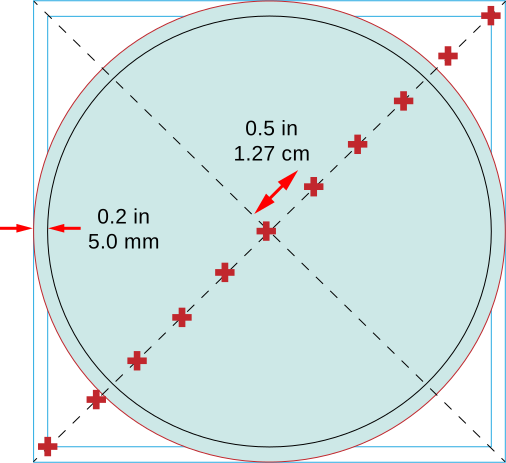
- Measurement points are taken starting at the center of the substrate and then radially outward every 0.5 inches (12.7mm), nominally (reference figure to the right).
- Uniformity calculation formula is: ((Max - Min) / (2 x Avg)) x 100% with a 0.2 inch (5mm) edge exclusion.
APPLICATION SPECIFIC OPTIONS
Vacuum Pumping Options
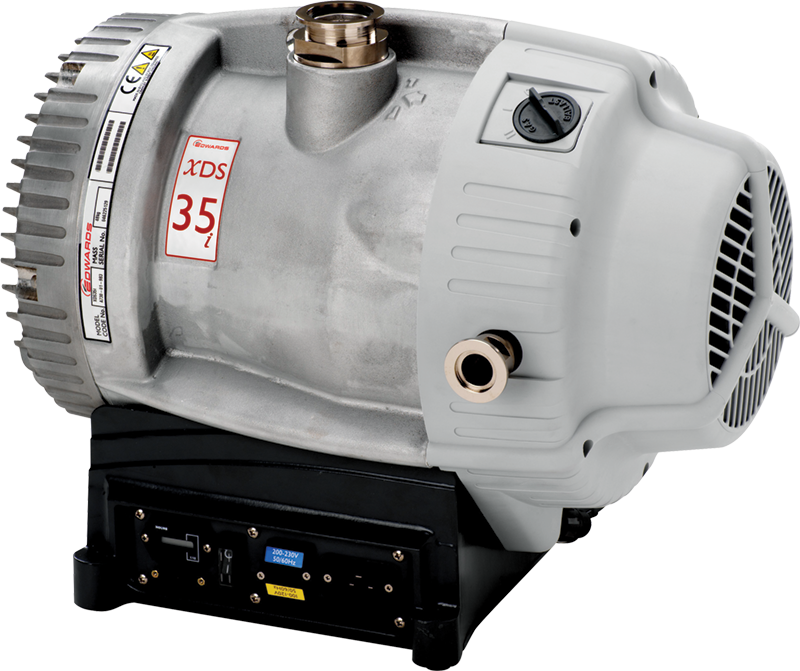
The vacuum system includes a Cryo Pump model CTI-8F with a pumping speed of 1500 liters per second. When the chamber is properly conditioned, this pump achieves a base pressure of 5.0 x 10⁻⁸ torr (6.67 x 10⁻⁸ mbar). Roughing pump options include two dry scroll pumps: the Edwards nXDS10i, which delivers a flow rate of 6.7 cubic feet per minute (11.4 m3/hr), and the Edwards XDS35i, offering a higher capacity of 20.6 cubic feet per minute (35 m3/hr).
Thermal Evaporation Source Options
- KJLC Thermal evaporation (TE) assembly, Up to four (4" or 5") thermal evaporation sources
- Standard thermal power supply, up to 12V or 400A, max 2kW applied power
- High output power options, up to 12V or 600A, max 2.5kW applied power
- Quartz crystal controller is available with thermal options
Substrate Fixture Options
Multiple available substrate fixtures capable of operating at LN2 temperatures, or -30°C with rotating fixtures. Precision tilting and rotating fixtures are available to enable the formation of high aspect ratio indium films. Substrate cooling promotes out-of-plane indium growth, resulting in fine grain structures and smooth film surfaces ideal for bump bonding applications. Indium bumps can be deposited by employing substrate masks affixed to the fixture.
Ion Source Options
The ion source, positioned either in a separate cooled chamber or within a isolated housing inside the process chamber, is safeguarded from indium contamination. Featuring a gridded design with an optional filament neutralizer, it effectively removes the oxide layer that forms on indium and can perform a light etch on the deposited metallic film. As a result, the indium film remains virtually free from contamination, ensuring optimal interfaces for bonding.



Load Lock Options
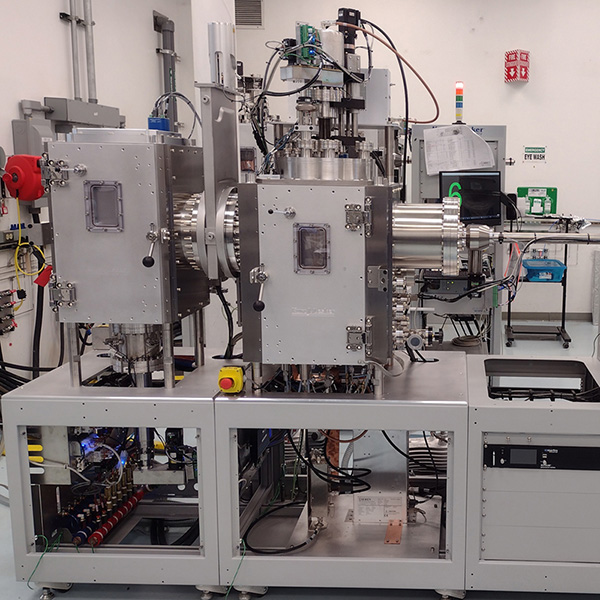
- Low profile design
- Load Lock, turbo pump, and all appropriate gauging
- Compatible with substrates up to 200mm, multisite adapter for smaller substrates
- 67 L/s turbomolecular pump set with isolation valve
- Roughing pump shared with process chamber
- Isolation valve between load lock and process chamber

Architecture Overview
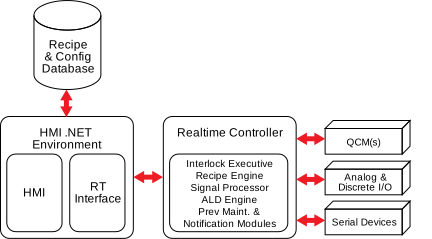
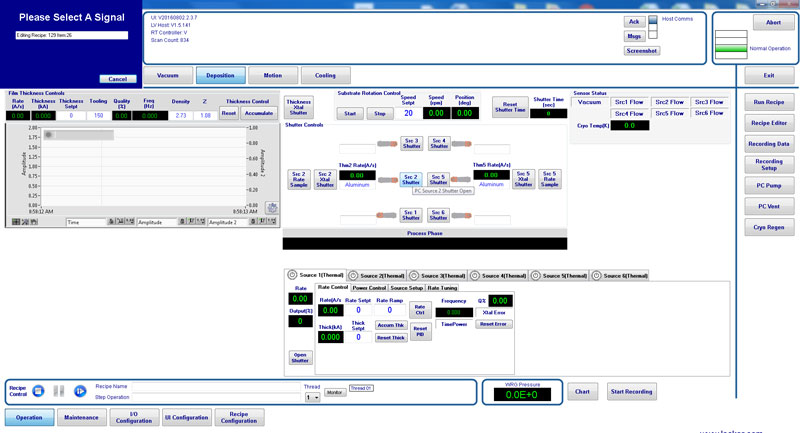
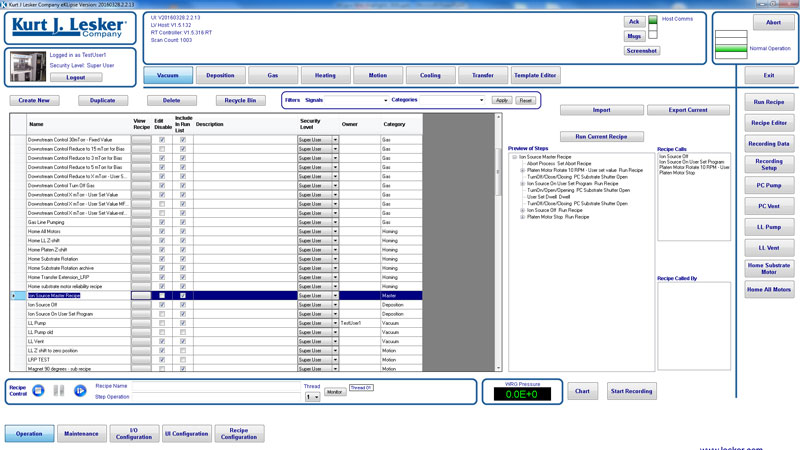
Kurt J. Lesker Company® eKLipse™ Controls Software is utilized on all KJLC platforms. The eKLipse™ controls platform utilizes a .NET application running on a Windows PC for its User Interface and Recipe Editor. Equipment automation is accomplished via a standalone Real Time Controller.
AI-Ready, Powered by eKLipse
Our process equipment platforms are engineered for seamless integration with external AI tools, enabling real-time recipe optimization, predictive analytics, and remote decision-making. Powered by eKLipse software, each system ensures intelligent control with minimal complexity allowing you to scale efficiently in a data-driven environment.
Learn More About eKLipse AI-Ready Thin Film Deposition Systems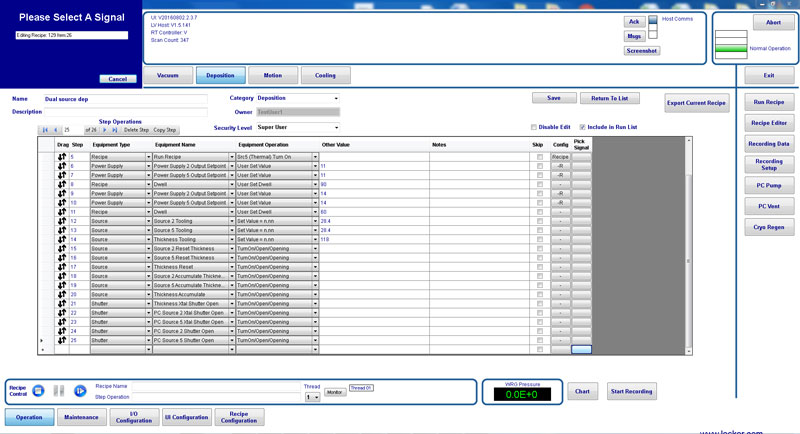

Recipes
- Graphical Recipe Builder – Easily create recipes by clicking on the desired component and set that item's attributes
- Scripted Recipe Builder – A more traditional "scripted" recipe editor exposes more details for setting or checking the value of any system component during a process.
Reliable
- Real Time Controller – The system operates independently of the Windows software package and will continue the recipe should the software / computer malfunction.
- Independent Thermal Evaporation Thin Film Control – There is no third party software requiring a "handshake" or "handoff" between the Systems Manufacturers software and the thin film controller's software.
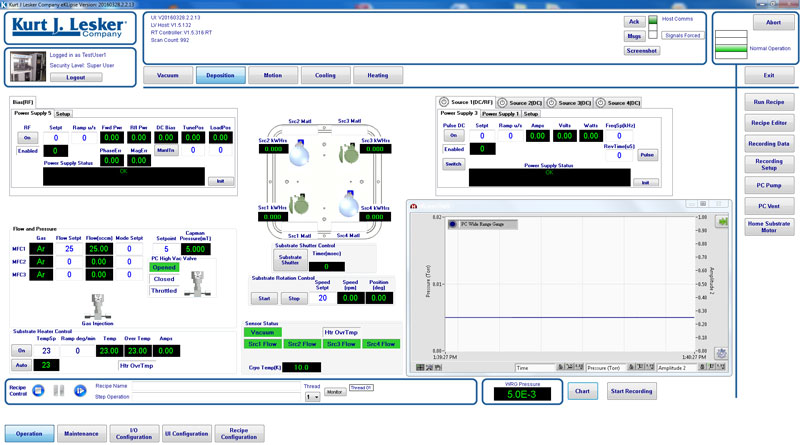
Unlimited Recipes, (import/export capable)
- Unlimited recipes with user security level features
- Recipe import/export capability (for transferring recipes between similarly equipped tools)
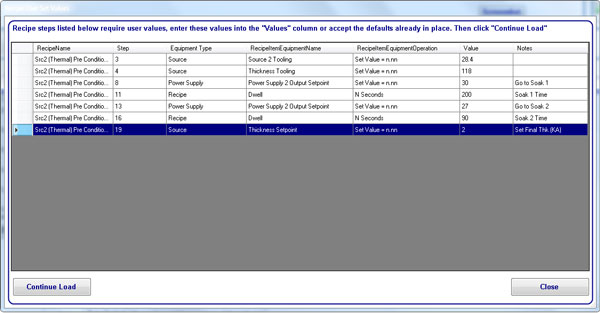
- Any recipe step can be configured to allow the user to alter a value, enabling process condition changes, without affecting the master recipe. As an example, at the time of execution, the recipe can prompt the user for the desired deposition thickness, or power setting.
- Consistent User experience across all deposition techniques and KJLC platforms (Sputter, Thermal, EBeam, ALD)
- Multi chamber and multi PC control for cluster tools
Custom Chart Recorder and Datalogging
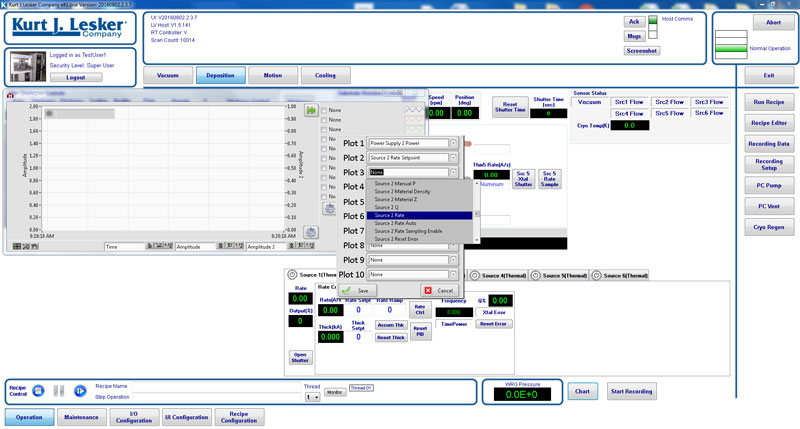
- Custom Chart with up to 10 simultaneous plots
- Chart Recorder can be used to display any setpoint or feedback parameter
- Automatic datalogging of each recipe step for all recipes
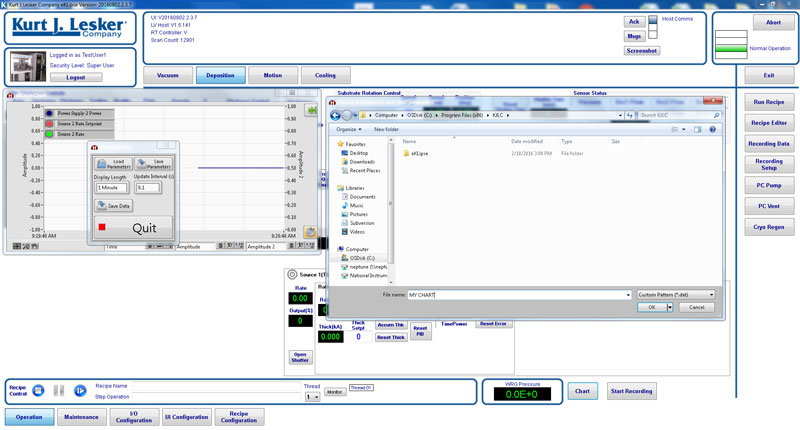
- Chart data and configuration can be saved
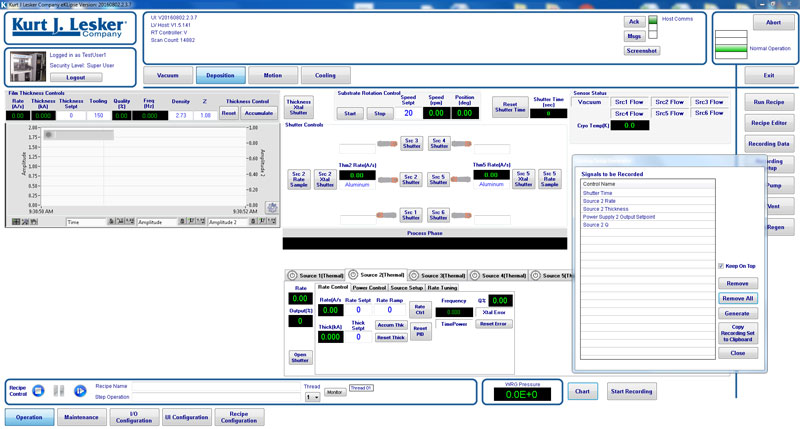
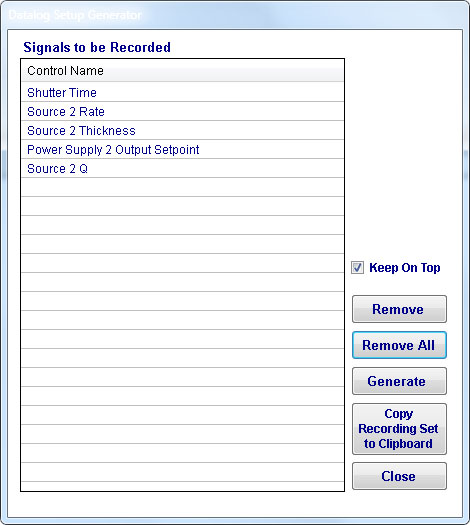
- Graphical selection of signals to be recorded
Custom Maintenance Counters
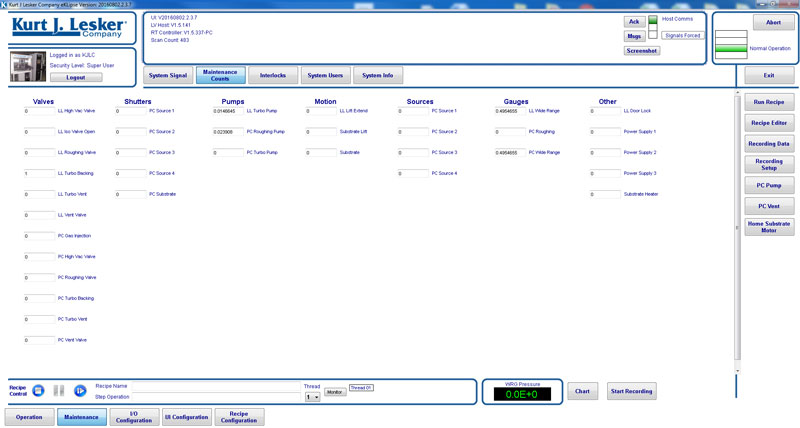
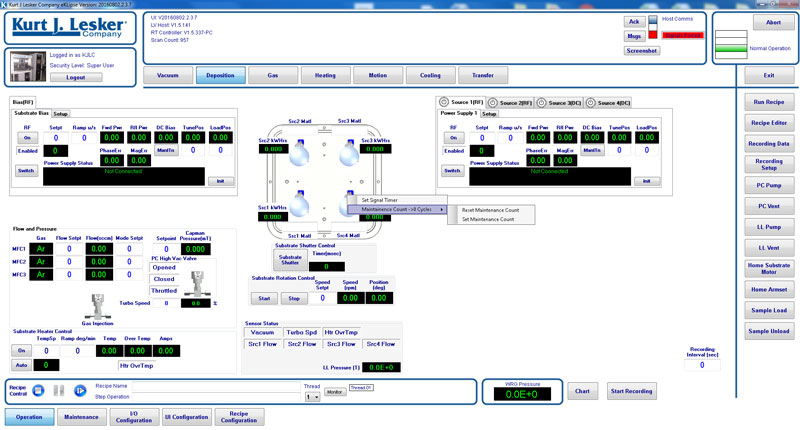
- Custom Maintenance Counters are available for each component
- Periodic Maintenance interlocks and recipe checks can be configured for any maintenance counter
- Sputter Target kiloWatt*Hour and custom material usage tracking
User Security
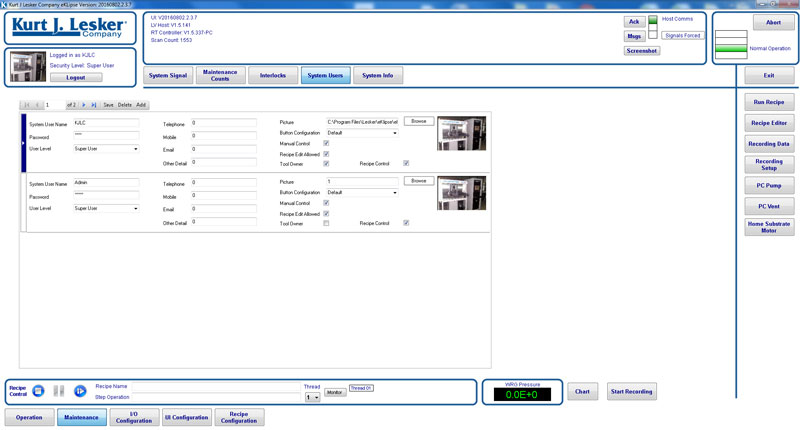
- Supports multiple user accounts and password levels with custom security access for recipes and screens
- Software screen access can be customized per user
- Recipe editing and manual operation features can be assigned on a per user basis;
- Users with full access have the ability to edit recipes and control interlocks. Restricted access users will be limited to running certain recipes and have no control over interlocks.
- Every control object can be assigned to a standard user security level.
- Individual screen access can be separately assigned to any user.
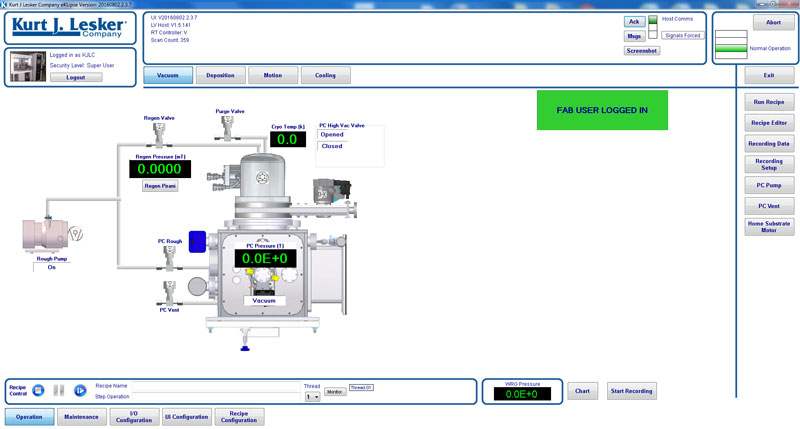
Multi User Facility Features
- System event log captures all user login/logout events, all recipes executed, and system status messages
- Interlocking of vacuum and deposition equipment provides continuous system status monitoring while restricting unapproved system usage (no need to 'power off' system screen or PC)